
HDC Handbook
Special Rules
HDC still includes castling, en passant, and promotion. These rules remain familiar, but they are adapted to three-dimensional space.
This page explains the three special rules clearly enough that you can recognize them in play.
Remember
Special moves are also made only on the 2D board. If a special move is legal, the app marks the relevant target squares there.
Castling
HDC has two forms of castling:
- horizontal castling like in classical chess
- vertical Z-castling along the layers
Shared conditions
For every castling move:
- the king and the involved rook must never have moved
- the king must not start in check
- the squares between them must be empty
- the king must not enter or cross an attacked square
- castling is one move: king and rook move together
Horizontal castling
This happens on layer IV.
Short
Notation: O-O
White example:
- king:
E1–IV → G1–IV - rook:
H1–IV → F1–IV
Long
Notation: O-O-O
White example:
- king:
E1–IV → C1–IV - rook:
A1–IV → D1–IV
Black castles accordingly on rank 8.
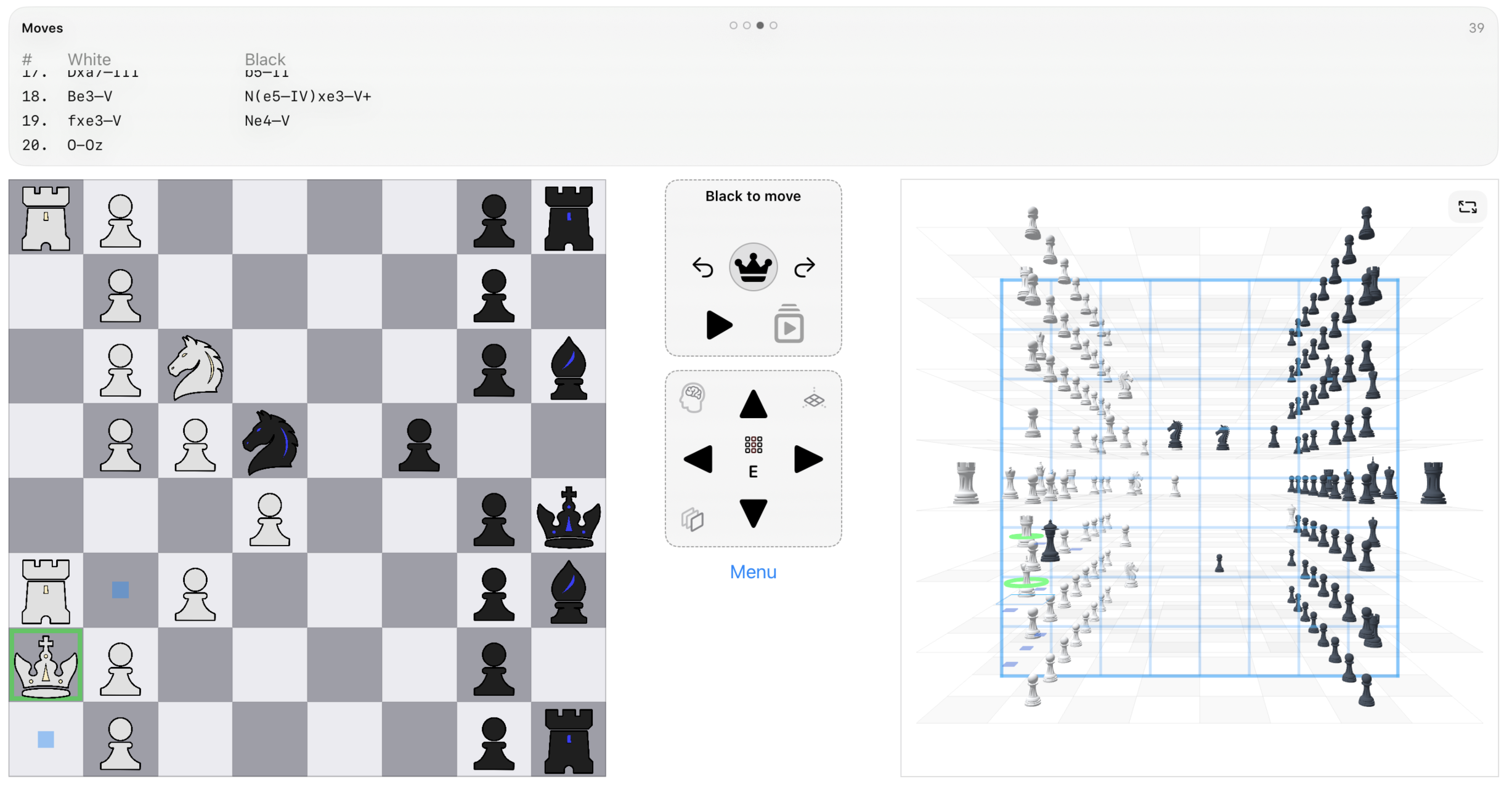
Vertical Z-castling
This is the HDC-specific castling move along file E.
Lower Z-castle
Notation: O-Oz
White example:
- king:
E1–IV → E1–II - rook:
E1–I → E1–III
Upper Z-castle
Notation: O-O-Oz
White example:
- king:
E1–IV → E1–VI - rook:
E1–VIII → E1–V
The same safety rules apply as in horizontal castling.
En passant
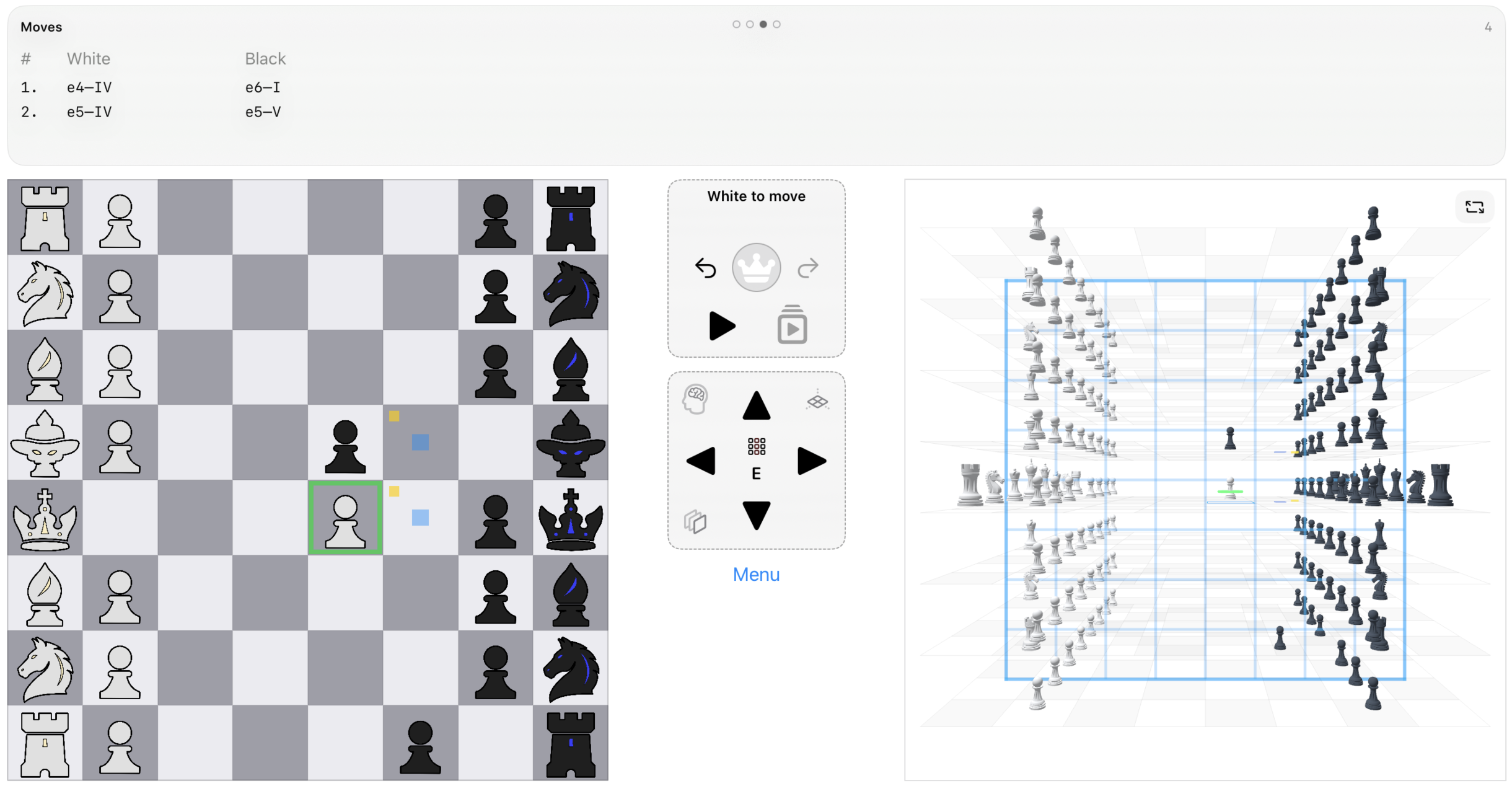
In HDC, en passant still works only on the immediately following move after the opposing pawn’s double-step.
Core idea
The capturing pawn moves to the skipped intermediate square.
What is new in HDC
Because pawns can also capture diagonally with a layer change, en passant in HDC is not limited to the same layer.
In principle there are:
- the classical XY version
- an additional YZ version involving layers
Notation
Add: e.p.
Examples:
exd6–IV e.p.e5–Vxe6–IV e.p.
Promotion
A pawn is promoted as soon as it reaches the final enemy rank.
- White at Y = 8
- Black at Y = 1
This applies on every layer.
Promotion choices
- Queen
- Duke
- Rook
- Bishop
- Knight
No promotion to a king.
Notation
Add =Piece, for example:
e8–II=Q...=D
Why special rules matter so much in HDC
Castling
It is not only protection, but also spatial repositioning.
En passant
It shows that pawn logic remains precise even inside the 3D system.
Promotion
It can happen on every layer and can create powerful new piece choices, including the Duke.
Common mistakes
- forgetting Z-castling
- trying en passant too late
- overlooking attacked transit squares in castling
- expecting promotion only on layer IV
- forgetting the Duke as a promotion option
Mini FAQ
Does HDC really have two castling directions?
Yes. A horizontal one on layer IV and a vertical one along the Z-axis.
Can en passant involve a layer change?
Yes, in principle through the YZ capture logic of pawns.
On which layers can promotion happen?
On all layers. The deciding factor is the reached rank, not the layer.
Can I promote to a Duke?
Yes.